
PSOP
Physical Security Observability Platform
Operational visibility for cameras, recorders and the infrastructure behind them. PSOP keeps device connectivity, observed function and the freshness of each observation as separate, inspectable evidence.
- React
- TypeScript
- NestJS
- PostgreSQL
- Prisma
- Python
- Turborepo
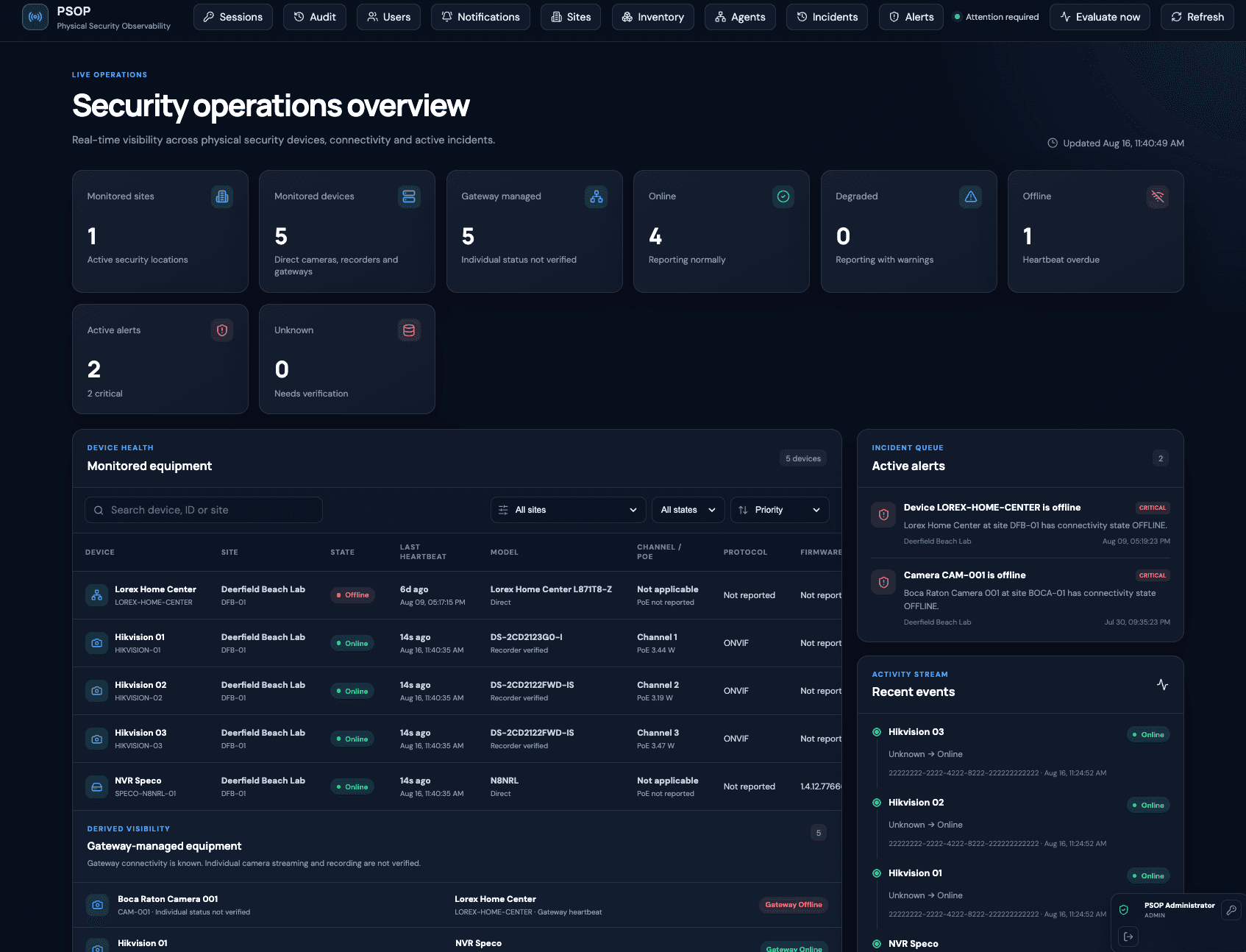
“Online” is not the same as working
Collapsing everything into a single online indicator hides the difference between device connectivity and the function an operator actually depends on.
- A camera can answer on the network without producing usable video.
- A stream session can be negotiated and still deliver no video packets.
- A check that passed earlier may no longer describe the site.
Fifteen years of field work with CCTV, alarms and monitoring in Brazil showed the gap firsthand: a recorder reported as online is not proof that a recording exists. PSOP turns that field question into software:
What evidence do we have that this part of the security system is working — and how recent is it?
From the device to inspectable evidence
- Lab siteReal hardware
A recorder, IP cameras and a gateway-managed device group on a lab network
- Edge gatewayPython
Recorder adapter, ONVIF/RTSP probes and a stream scheduler collect observations
- PSOP APINestJS · TypeScript
Authenticated ingestion, organization-scoped devices, sites and alerts
- Evidence ledgerPostgreSQL · Prisma
Each observation stored with its source, confidence, level and time
- Operator dashboardReact · Vite
Fleet health, site topology, incidents, activity, sessions and audit
Can the collector reach the device?
Is the device doing the job an operator depends on?
Is the observation still recent enough to describe the site?
A ladder of proof, not a status light
Every observation records how far up this ladder it reaches. The levels are defined in PSOP's data model; how far each has been proven is stated explicitly.
Direct-camera discovery still pending
- E0 · Unknown
- E1 · Endpoint reachable
- E2 · Identity observed
- E3 · Profile discovered
- E4 · Stream URI obtained
Through the Speco NVR, three Hikvision channels
- E5 · Session negotiated
- E6 · Media received
Next evidence to produce
- E7 · Recording proven
- E8 · Retrieval proven
E5/E6 were first measured through the recorder's own RTSP service, with a stream URI taken from the recorder UI. They are authenticated probe attestations, stored with OBSERVED confidence — never promoted automatically.
Implemented, validated and planned — kept apart
- Organization-scoped API — NestJS, PostgreSQL, Prisma
- Roles: Admin, Operator and Viewer
- TOTP MFA with recovery codes; mandatory first-login password change
- Refresh-token rotation, session revocation and replay protection
- Audit log of administrative activity
- Sites, devices, telemetry and connectivity events
- Alerts with a resolution workflow and email notifications
- Evidence ledger with source, confidence and level
- Gateway-derived status for gateway-managed devices
- Site topology, incident rail and activity stream
- RTSP session negotiation (E5) and received RTP video packets (E6) on three Hikvision channels through a Speco NVR
- Speco watcher recovery path running against real lab telemetry
- Direct-camera hardware validation
- Sustained periodic-scheduler operation
- Recording and retrieval proof (E7–E8)
- Dependency-aware operational topology and incident analysis
- Additional documented vendor adapters
- Deployment readiness: delivery, supervision and installation guidance
Tested against a real database, on every change
The PSOP CI workflow runs on pull requests and pushes to main. Migrations and the integration suites run against a PostgreSQL 16 service container.
- Prisma schemaSchema validation
- MigrationsApplied to a PostgreSQL 16 service
- Unit testsAPI · Jest
- Integration testsAPI e2e suites, including security
- BuildsAPI build · dashboard type-check & build
- 17
- API unit test files
- 6
- API integration suites
- 17
- Python gateway test files
- security
- fleet
- telemetry-ingestion
- device-availability
- device-intelligence
- site-fleet-reliability
Run history is public in the repository's Actions tab.
Lab-stage work, stated as such
PSOP is not a deployed commercial platform. Lab validation describes specific hardware observations — not general manufacturer compatibility or production readiness.
- Runs in a lab environment — not deployed as a production service
- Validated hardware: one Speco NVR and three Hikvision cameras
- E5/E6 results are authenticated probe attestations, not independent packet captures
- The data model covers more device types (access controllers, sensors, intercoms, switches) than the lab has validated