
02 — Field Operations · Business Software
FSOP
Field Service Operations Platform
One workspace for the work a field-service business runs on — from the first request to the final payment.
- Next.js
- TypeScript
- Supabase
- PostgreSQL
- Tailwind CSS
- Vitest
01Overview
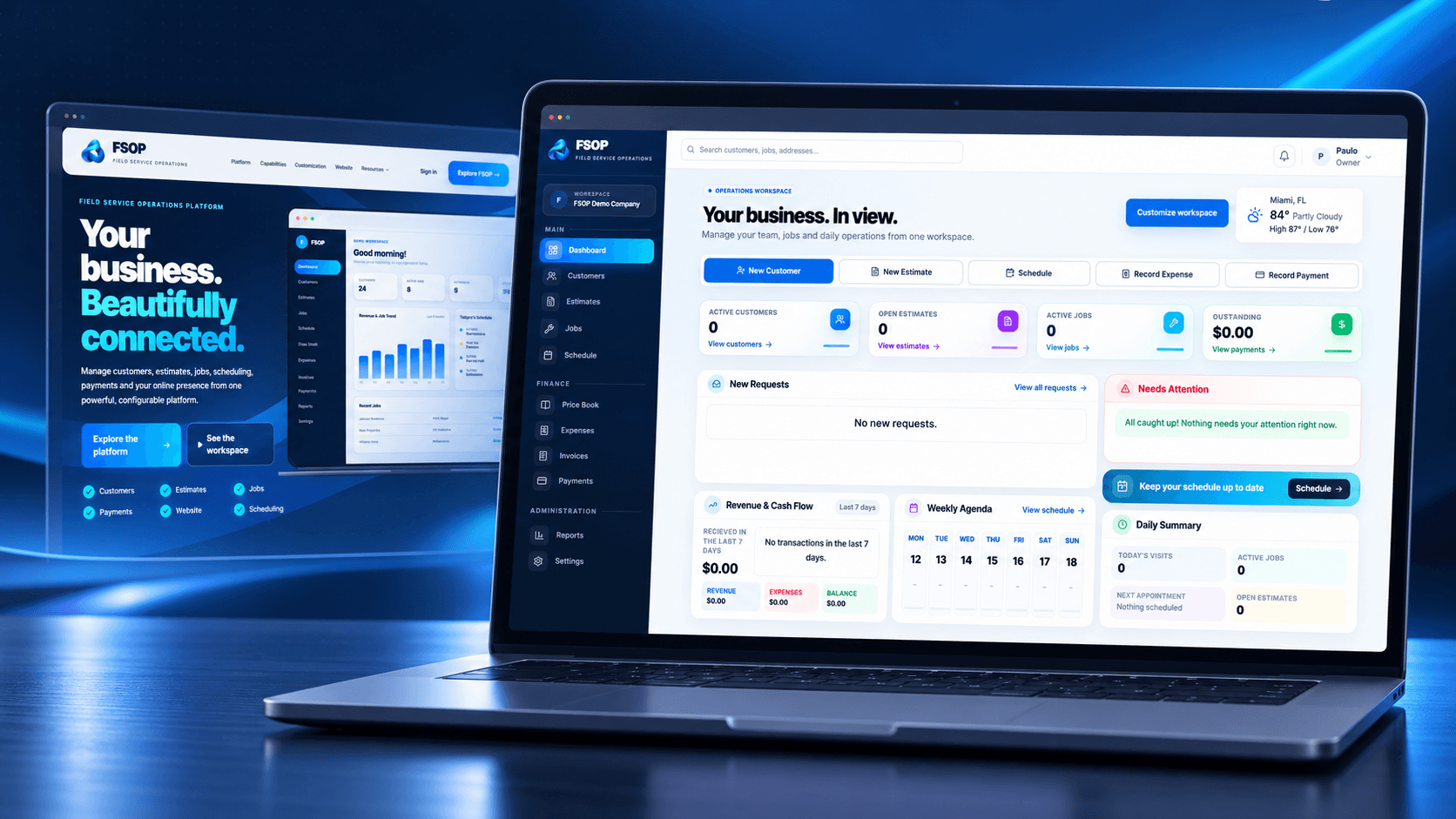
FSOP is a multi-tenant field-service operations platform built as two connected products: a public business website where customers request work, and an authenticated owner portal where that work is priced, scheduled, invoiced and tracked through to payment.
The platform grew out of a real-world implementation for BlueWave Plumbing, a plumbing-services business. That first implementation shaped the workflows against a working business; FSOP generalizes them into a configurable platform.
02Problem
For a small field-service business, a request, its estimate, the job, the visits, the expenses and the payment are one piece of work — but they usually live in separate places. That makes it hard for the owner to know which jobs are worth taking before work starts, and whether they were worth it afterwards.
03Approach
- One connected flow: request → estimate → job → invoice → payment
- Every estimate carries its own total, profit and margin; jobs track actual costs
- Internal profitability stays internal — customer documents show scope, line items, total and payment schedule only
- Owner and assistant roles, with financial data restricted to the owner
- Company data isolated with Postgres row-level security on every table
04Product
Screenshots from the first real-world implementation, BlueWave Plumbing. Client names and contact details are redacted.
- Customers and price book
- Estimates with profitability, plus professional estimate PDFs
- Jobs with actual costs and profitability tracking
- Scheduling and visits
- Expenses, payments and invoices
- Public website in English, Portuguese and Spanish with Request an Estimate
05Architecture
A Next.js App Router application in strict TypeScript on top of Supabase Postgres and Auth. Multi-tenancy is enforced in the database: every policy resolves the signed-in user’s company, and sensitive transitions — such as converting an estimate into a job — run as database functions rather than client-side logic.
The design system is implemented as first-party components with centralized design tokens, without a third-party component framework.
06Technology
- Next.js
- TypeScript
- Supabase
- PostgreSQL
- Tailwind CSS
- Vitest
07Current status
Building. Customers, price book, estimates, jobs, scheduling, expenses, payments and invoices are implemented and verified, along with the multilingual public website and lead capture.
08Next direction
- Reports — scoped first to the metrics current data can support accurately
- A company settings page for business details that are not yet editable in the UI